
Compliance and safety
Nothing on your fleet expires without warning
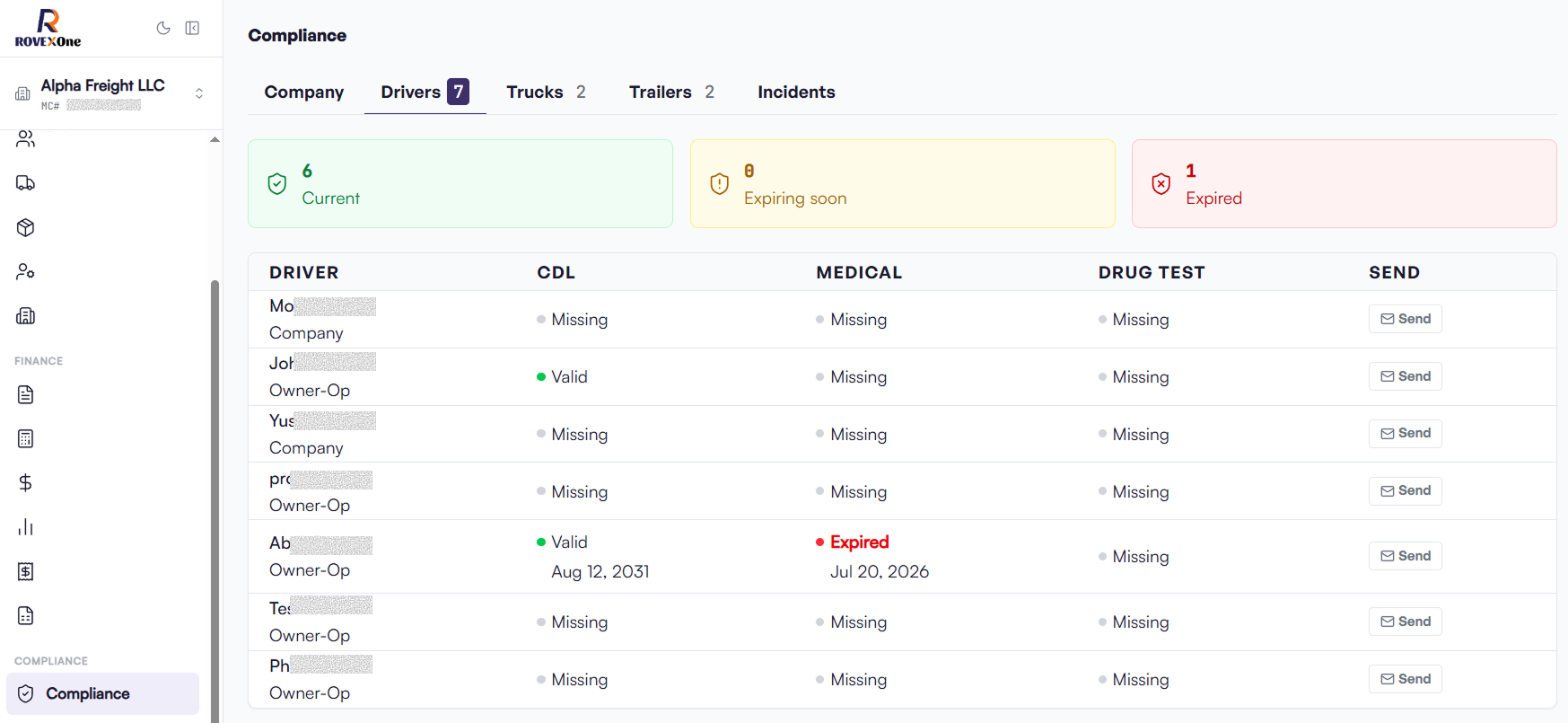
CDLs, medical certificates, insurance certificates, and every other document you have to keep live in one vault, per driver and per company. Alerts fire 30 days before an expiration date. Incidents log with their test flags, citations, police reports, and attachments in one record.
14-day free trial · No credit card charged today
The problem
Compliance is quiet right up until it is not
A medical card expires on the 14th. Nobody notices. The driver runs three more weeks, gets inspected, and now you have an out-of-service violation on a driver who was perfectly healthy and just needed an appointment.
Or the insurance certificate lapses on a Friday and you find out because a broker will not tender you a load Monday morning.
Or a DOT auditor asks for the driver qualification file on somebody who left eight months ago, and it is in a filing cabinet, or in an email, or on the laptop of the office manager who quit.
None of that happens because anybody was careless. It happens because expiration dates live in documents and nobody reads documents until they need them.
Document vault
One place for everything you have to be able to produce
Store any document against a driver or against the company. CDLs, medical examiner's certificates, insurance certificates, drug and alcohol testing records, employment applications, MVRs, W-9s, authority paperwork, whatever your insurer or your brokers ask for.
Every document carries an expiration date. That date is the whole point: it is what turns a filing cabinet into a system that tells you something.
Per driver
Everything on one driver in one place, so when an auditor or an insurer asks, it is a lookup.
Per company
Authority documents, insurance certificates, and anything that belongs to the operation rather than a person. If you run more than one MC number, each authority's documents stay with that authority.
Alerts
Thirty days of notice on everything
Alerts fire automatically 30 days before any document expires. That is enough time to get a physical scheduled, get a renewal processed, or get a certificate reissued without pulling a truck off the road.
Thirty days matters more than it sounds. Two weeks is not enough to get a DOT physical appointment in most markets. A week is not enough to get anything from an insurance agent. A month is the difference between handling it and scrambling.
Incidents
Log accidents and DOT-required Incidents
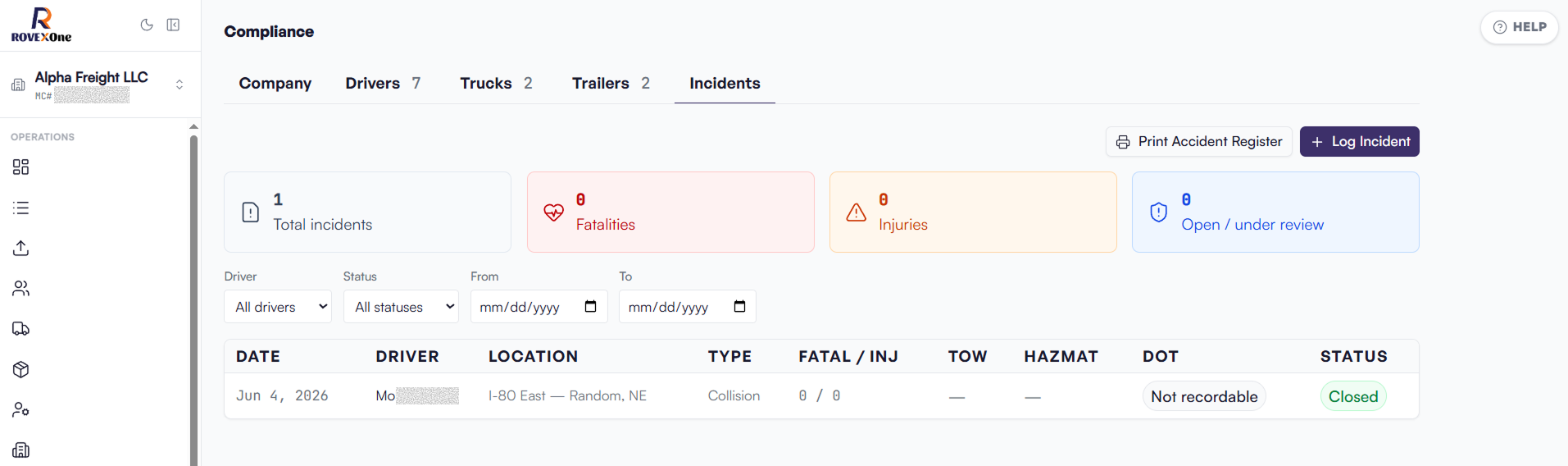
Log accidents and DOT-recordable events as they happen, with everything attached to the same record:
- Date, location, and description
- Drug and alcohol test flags, so post-accident testing status is on the record rather than in somebody’s memory
- Citations issued
- Police report number and the report itself
- Photos, statements, repair estimates, and any other document
Six months later, when the insurer or the auditor asks, the record is complete and it is dated. The version reconstructed from memory and a text thread is neither.
Equipment
What you have, where it is, and what has been done to it
Truck and trailer records carry the VIN, the plates, the ownership type, the current status, the current assignment, and the service history.
Service records live on the unit, so the maintenance a truck has had follows the truck. That matters most when equipment changes hands between owner-operators, or when you are deciding whether the next repair is worth doing.
Scheduled preventive maintenance reminders by mileage or time interval are not part of the current release.
Who sees what
Compliance is gated by default
Three access levels: owner, full access, and operations. Compliance and financials are closed to operations users, who see dispatch only. Medical records, test results, and incident files are not something every dispatcher needs open on his screen.
What is included
Every compliance feature, on every plan
- Document vault, per driver and per company
- Expiration dates on every document
- Automatic alerts 30 days before expiration
- Incident logging for accidents and DOT-recordable events
- Drug and alcohol test flags on incident records
- Citation and police report tracking with attachments
- Hosted public driver application form
- Applications inbox
- One-step conversion from application to driver record
- Hosted public quote request form
- Truck and trailer records with VIN, plates, ownership, status, assignment, and service history
- Access levels that gate compliance records
- Per-authority separation for carriers running more than one MC number
FAQ
Questions about compliance
Anything, against a driver or against the company. Carriers typically keep CDLs, medical examiner’s certificates, MVRs, employment applications, drug and alcohol testing records, insurance certificates, and authority paperwork.
Get started today
Load your driver files and find out what is already expiring
Upload what you have for one driver and see what the vault flags. Most carriers find at least one thing.
14-day free trial · No credit card charged today · Cancel anytime
RovexOne stores your records and notifies you of upcoming expiration dates. It is not legal or regulatory advice, and it does not determine what your operation is required to keep or report. Consult your safety consultant or counsel on your compliance obligations.